Redbuds
Michael Williams ; 2025-12-31 20:13:46
If your garden needs a little springtime sparkle, the Eastern Redbud is here to steal the show! With its branches dripping in magenta-pink blooms before the leaves even wake up, this tree knows how to make an entrance. It is compact, pollinator-friendly, and downright lovable—with heart-shaped leaves to prove it. Learn how to plant, grow, and care for eastern redbuds.
About Redbuds
Eastern Redbud (Cercis canadensis) is a smallish flowering tree native to North America. Flowers bloom in spring before the foliage appears, and the tree is loved for its relatively long-lasting display of pink to purple color.
It is modest-sized, 20 to 30 feet tall and wide at maturity, and grows at a medium rate of 12-18 inches per year, although young trees can grow faster. They typically reach 10 feet tall in about 6 years.
Redbuds in the landscape make fantastic specimen trees or anchors to perennial beds. As natural understory trees, they can be used to create a tiered effect with larger trees behind them, especially for yards that currently have all tall trees and nothing underneath. Such layering mimics natural forest conditions to our eyes and provides multiple levels of habitat for birds and insects.
Eastern redbuds serve as an important nectar source for early-season insects, and their seeds are enjoyed in autumn by northern bobwhites and chickadees.
Weeping Redbuds can make a dramatic show in your yard and, in summer, can provide a secret spot for a garden bench. Eastern redbuds make dramatic edges to woodland areas in small groupings. They are ideal for providing light shade in garden beds full of perennials.
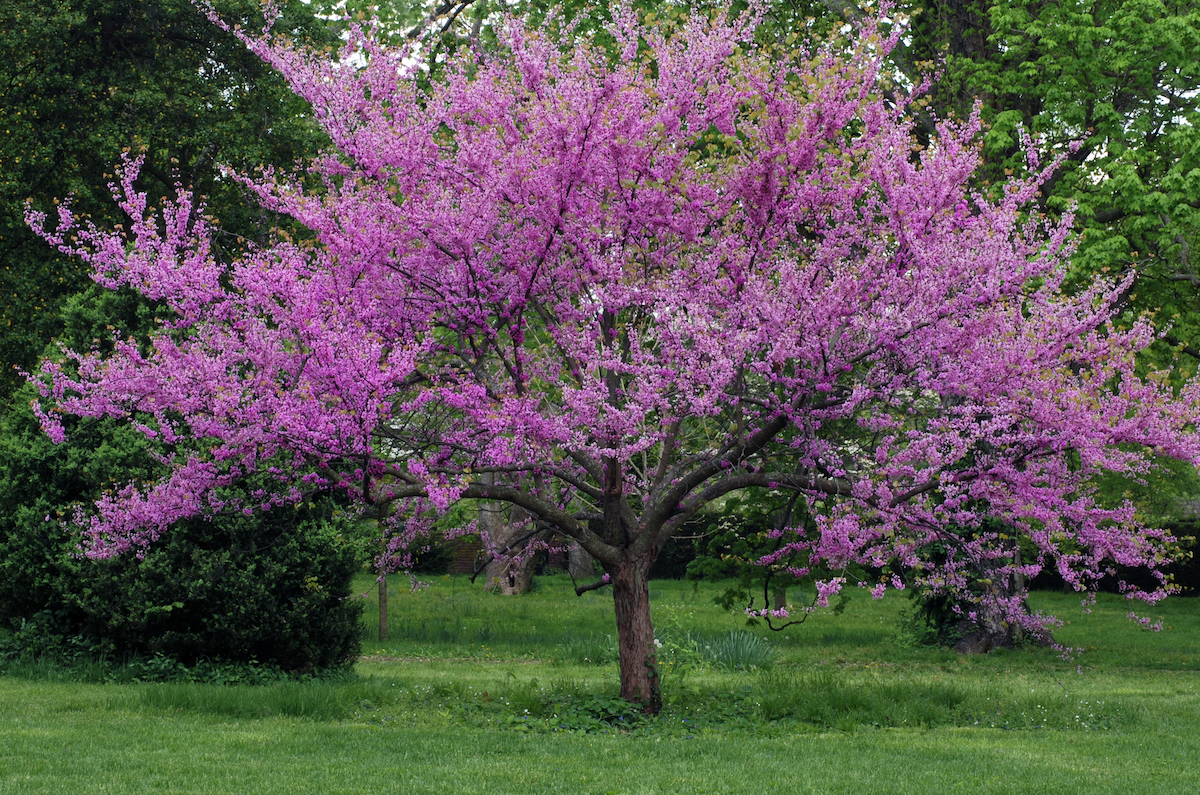
Eastern redbud tree in full bloom. Credit: Marie C Fields.
Planting
When to Plant Redbuds
Redbuds can be planted in either spring or fall. If planting in autumn, try to get the tree in the ground 4-6 weeks before your first frost. Bare root trees should be planted as soon as they arrive.
Where to Plant Redbuds
Eastern redbuds grow at a medium rate but eventually reach a modest size, so considering mature tree spacing is essential. When planted in full sun, they have a more round, lollipop shape; they are loftier, open, and airy when planted in partial shade.
These trees tolerate most soil conditions as long as the extremes of wet and dry are avoided. They are adaptable to many soil types and are not picky about pH.
How to Plant Redbuds
Planting redbuds is easy, and the same methods are used for planting other nursery stock. If planting bare-root trees, soak the roots in a bucket of water for 12 hours before planting.
- Remove any sod from the area, and use it to fill in holes in your yard.
- Dig a hole the same depth as the root ball and twice as wide. The hole should look like a shallow bowl, not a coffee cup.
- Loosen the soil at the edges and bottom of the hole. Don’t leave hard, compacted sides or bottoms that will be difficult for roots to penetrate (or for water to drain).
- Remove the tree from its container and prune all circling or girdling roots. Root-bound plants will benefit from the scoring of the root ball to stimulate new growth in outward directions.
- Test fit the redbud in the hole. Check for depth and ensure no roots are bent over or circling in the hole. Enlarge the hole if necessary.
- Backfill the hole with the soil you removed, ensuring the tree is kept vertical while filling. Stop when the hole is filled halfway and tamp the soil firmly around the roots to remove air pockets, then provide a good drink of water. Continue filling the soil around the roots and firming it with your hands.
- Mulch around the tree, about 3-4 inches thick. Spread the mulch evenly in a circle extending 2-3 feet from the trunk. Don’t allow the mulch to touch the trunk—keep an inch or two of separation. The final mulch job should look like a flat disc, not a mound.
Learn more about planting bare root trees.
Growing
How to Grow Redbuds
Redbuds grow quickly when young and then slow to a medium growth rate. Provide supplemental watering while the tree is establishing and during extended dry periods. Prune redbuds when young for shaping. They can be trained as multi-trunk or single-trunked plants.
How to Prune Redbuds
Prune any undesired branches in winter when the tree is dormant or after flowering is complete in spring. Remove crossing, twisted, or suckering branches. Diseased or broken branches can be removed at any time of year.
How to Propagate Redbuds
Eastern redbuds are cooperative in propagating from seed and challenging in doing so from cuttings.
Winter sowing makes planting these a snap, but you can collect and dry seed, too.
- Collect seeds when the pods have turned brown in autumn.
- Ripe seeds can be immediately planted into the ground in the fall, allowing nature to do the work for you. Otherwise,
- Remove the seeds from the pods and air-dry them for storage until they are ready to plant.
- Eastern redbud seeds have a stout coating and need cold to break embryo dormancy.
- Soak seeds in boiling water for 1 minute, then remove.
- Cold-stratify seeds in the refrigerator for 60 days to break dormancy.
- Plant the soaked and stratified seeds in standard potting mix ¼ to ½ inch deep. Keep moist until germination occurs.
If you’d like to trypropagating redbud from cuttings, try this method. Good luck!
- Take softwood cuttings 4–6 inches long.
- Treat cuttings with 8000 ppm (0.8%) IBA talc.
- Stick in 1:1 coir and perlite mix and provide humidity (plastic bags or humidity domes and frequent misting can simulate nursery propagation misting).
- Provide bottom heat at 70–75℉ until rooting begins.
- Keep the ambient temperature at 75°F, no colder.
- Once rooting commences, provide supplemental lighting (12 hours daily) to encourage faster root development.
Types
- ‘Appalachian Red’ - deep colored buds unfurl to reveal neon pink blooms.
- ‘Forest Pansy’ - bright purple foliage emerges and slowly deepens in color, fading to dark green. Foliage may keep a purple tinge through the season in regions with cool summer weather.
- ‘Lavender Twist’ - lovely umbrella-shaped, cascading habit. A perfect spot for a garden bench.
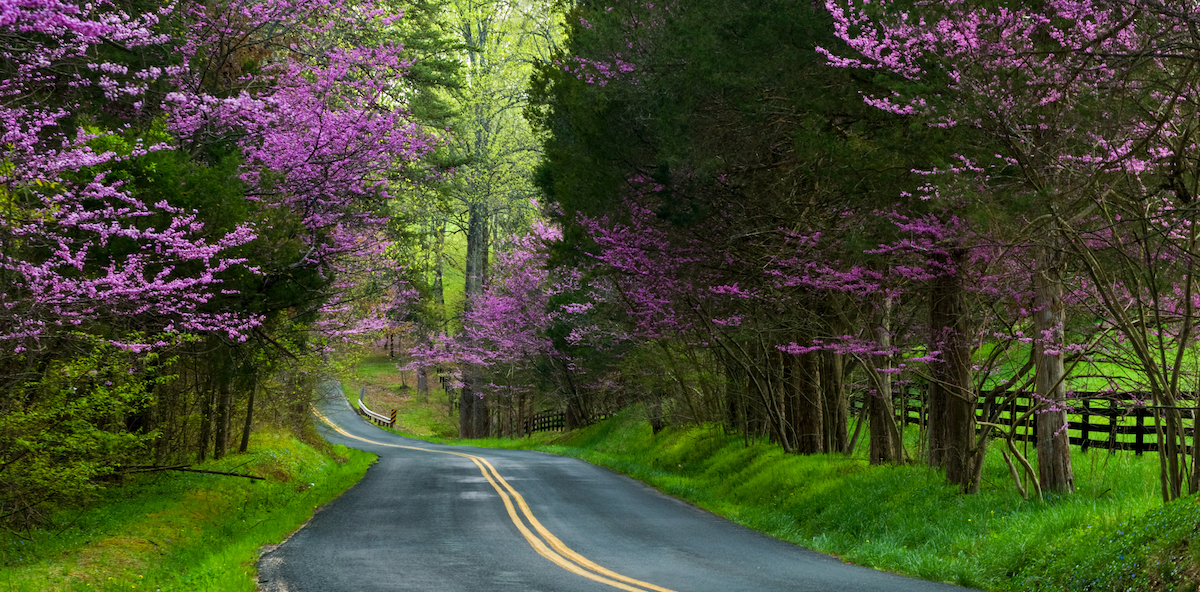
Eastern Redbuds as classic understory natives. Credit: Gerry Bishop
Pests/Diseases
- Scale insects
- Verticillium wilt
Wit and Wisdom
- Cercis(the genus name) comes from the Greek wordkerkis, meaning weaver’s shuttle, referring to the shape of a shuttle used on a loom.
- Redbuds can be very sensitive to herbicides. Take care if you or a neighbor use chemicals on the lawn.
- George Washington reportedly transplanted redbuds from nearby woods into his gardens.